


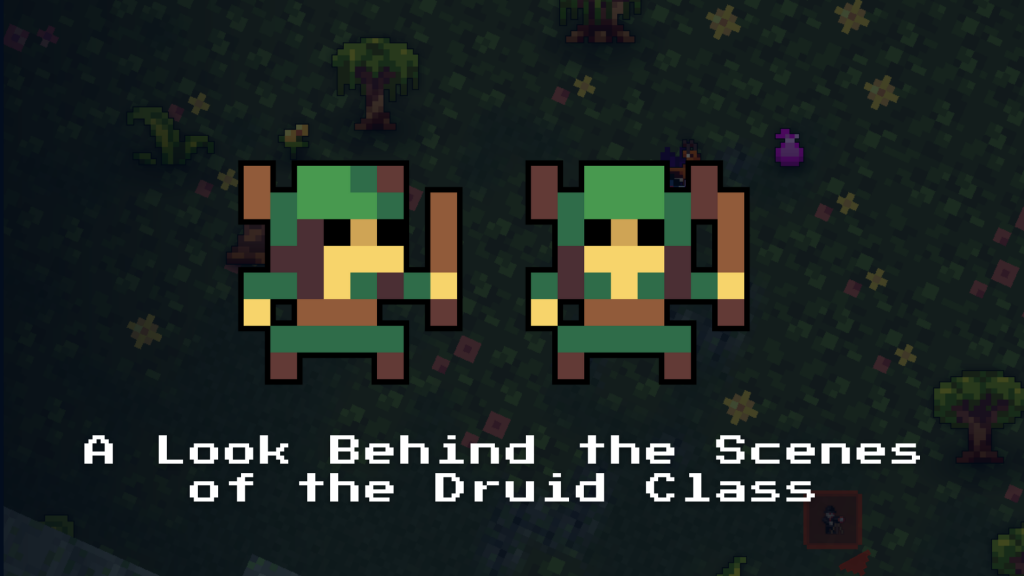
We’re excited to share that the Druid class is planned to release in the first quarter of 2026.
As we get closer to launch, the team wanted to offer some insight into how the class came together, from its original concept to the mechanics and visuals that shaped its final form.
When the idea for the Druid first came up, what design gap or goal was the class meant to address within the existing roster?
The idea for the Druid came up during early discussions around new class additions while we were working on Summoner. At the time, Summoner, Kensei, and Druid were all being considered as potential options. Summoner felt like the most straightforward choice to develop first, but the Druid concept stuck with us as something we wanted to explore later. The goal was to eventually introduce a class that leaned more heavily into transformation.
What core fantasy or identity did you want the Druid to embody, and how did that guide its design?
The Druid is rooted in a nature focused fantasy, with an emphasis on transformation into different animals. From the beginning, the idea was not just about casting spells, but about building toward powerful moments. We wanted the transformation itself to feel impactful, closer to an ultimate ability in other games rather than something that could be triggered constantly. That idea guided the pacing and the weight behind the class’ core mechanic.
How did you ensure the Druid felt distinct from other classes like Sorcerer and Summoner?
While the Druid shares a wand-based attack style with Sorcerer and Summoner, the goal was to create a class that emphasizes gameplay expression and adaptability. Druid rewards awareness of your surroundings and smart use of its tools in the moment, with gameplay centered around shifting forms, reacting to the situation, and maintaining momentum. This gives it a distinct role in the roster, where Sorcerer focuses on area control and Summoner on managing minions from a safe distance, Druid does well on fluid decisions and actively adapting to the fight.
Can you walk us through the Druid’s main mechanics and how they evolved during development?
The core mechanic of the Druid is centered around building a meter and transforming once that meter is full. Earlier in development, we experimented with an ability switching system where the Druid could change between different animals more freely. While interesting on paper, it became too complex and did not feel particularly fun in practice. Over time the focus shifted toward a clearer buildup and payoff structure that was easier to understand and more satisfying to play.
Which ability or system changed the most from early prototypes to the final version, and why?
The meter building system went through the most iteration. We tried versions where the meter built only through ability use, then versions where it was tied to both ability use and basic attacks. We landed on a system where the meter builds through using abilities and successfully hitting enemies.
Were there any mechanics or ideas that were tested but ultimately removed during development?
Early on, we experimented with giving each ability multiple transformation forms. While it added depth, it also introduced a lot of complexity that made the class harder to read and play. In the end, simplifying this aspect helped the class feel more approachable without losing its identity.
What were the biggest balance challenges when designing the Druid for both solo play and group content?
One of the main challenges was accounting for differences in pet progression. We needed to avoid a situation where players with high level pets could remain transformed almost permanently, while players with lower level pets struggled to transform at all. Finding a balance that felt fair and rewarding across different progression levels required a lot of tuning.
How did player testing and feedback influence the final shape of the class?
Public testing was very valuable. Players identified several bugs and were very direct about which parts of the class did not feel good to use. For example, players reported that shots spawning delayed behind the character, bugs with starting equipment and the usability of the UTs. With their help we improved the feel and fixed bugs.
The feedback helped us prioritize the right improvements and make targeted changes that significantly improved the overall experience.
Was there a specific moment during testing when the Druid “clicked” and felt right to play?
That moment came after we applied the feedback from the first public testing session. Once those changes were in place, the class started to feel much more cohesive and enjoyable.
How did the class’s visuals and theme develop alongside its gameplay mechanics?
The visual development took time, largely due to the sheer amount of art required. Each transformation form needs its own skin, which meant a significant workload for the art team. This was a slower process, but the end result is a set of good quality visuals that we are very happy with.
Are there any parts of the Druid you’re particularly interested in monitoring or iterating on post release?
Everything! We are interested in monitoring for overpowered or underpowered indicators, how the class is perceived by the players and if players are switching different classes for playing druid. Also if they use the variety of UTs or if they stick with one specific UT. If they forge druid UTs in the forge, etc.
Finally, is there anything about the Druid’s development that players might not realize, or a message you’d like to share with players trying the class for the first time?
Design is an iterative process, and player feedback plays a big role in shaping how things turn out. Our goal is to make sure players will have a fun time with the class, and having them participating in the process and being vocal helps us a lot.
Thanks for taking a look behind the scenes with us. We hope you enjoy exploring the class and making it your own when it joins the Realm soon!